How many HP does a woodchipper need?
The rule of thumb is 3-4 HP per inch of branch diameter. Use our free calculator below for your exact setup, then scan the complete sizing chart.
HP requirements are one of the most-misunderstood parts of woodchipper sizing. Engine HP and PTO HP are different numbers. Wood species changes the working requirement. Feed type (gravity vs hydraulic) eats a few HP on top. Altitude reduces available power. And manufacturer ratings often assume ideal conditions that don’t match your woodlot.
This page covers all of it. Start with the HP sizing calculator directly below — enter your branch diameter, wood type, and feed style to get a personalized HP recommendation in seconds. Then read the detailed breakdown by tractor model, engine type, and real-world operating conditions, followed by our full PTO vs gas sizing tables at the bottom.
Woodchipper HP calculator
Tell us what you’ll chip. We’ll calculate the minimum and comfortable HP, then match woodchippers from our reviews that fit your spec.
Reading: A 6-inch hardwood chipper needs 35 pto hp for comfortable sustained chipping. Tractor PTO HP is typically 10–15% lower than rated engine HP.
Engine HP vs PTO HP — why the numbers differ
Tractors advertise engine HP (measured at the crankshaft). Chippers care about PTO HP (the HP that reaches the output shaft). Drivetrain losses — through the transmission, hydraulic pump, and PTO gearbox — reduce this by 10-15% on compact utility tractors and up to 20% on older machines.
A 35 HP engine tractor produces roughly 28-30 PTO HP. A 50 HP engine tractor produces ~42-43 PTO HP. Always size by PTO HP, not engine HP. Every chipper manufacturer lists PTO HP requirements for a reason — if you size by engine HP, you’ll come up short on hardwood.
For a deeper comparison of PTO-driven vs self-powered chippers, see our PTO vs gas woodchipper guide. If you’re not sure whether a PTO chipper is right for your setup, our sizing guide walks through the full decision tree.
HP requirements by specific tractor model
The most common question we get: “I have a [tractor]. What chipper can I run?” Here are eight popular compact utility tractors and the chippers they pair with, based on published PTO HP and our testing experience.
- Kubota L2501 (21.4 PTO HP) — Enough for 4-inch gravity-feed chippers like the Wallenstein BX36S or the MechMaxx BX42S. Tops out at 4-inch branches; don’t push it into 6-inch territory.
- Kubota L3901 (33.5 PTO HP) — Solidly in 6-inch chipper range. Runs the Wallenstein BX52S comfortably and can handle the Woodland Mills WC68 on softwood and green material.
- John Deere 3032E (25.2 PTO HP) — Pairs well with 4-to-5-inch chippers. The Woodland Mills WC46 is a natural match, and the Wallenstein BX52S works on lighter material.
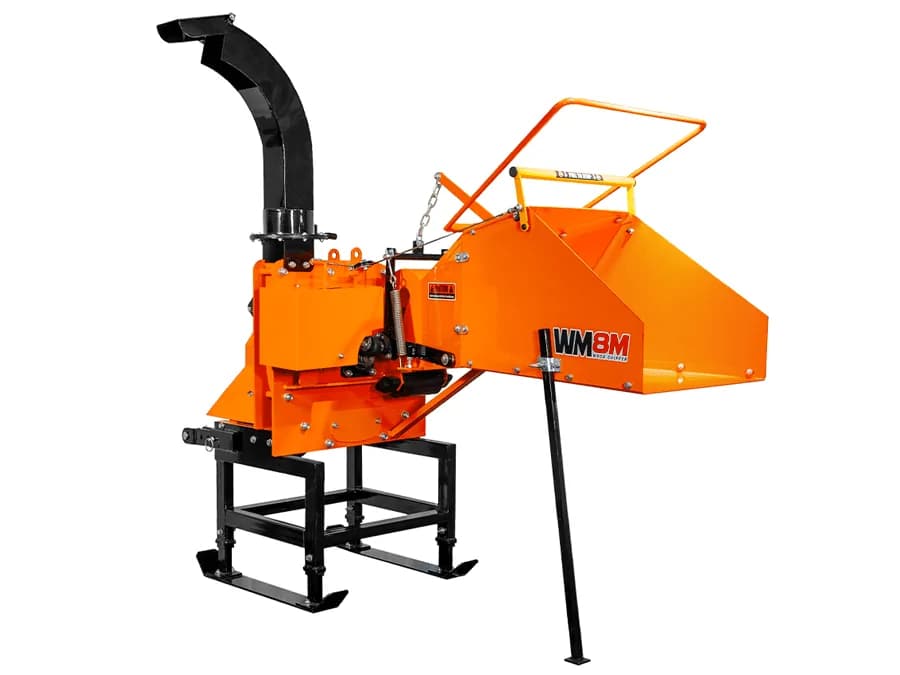
- John Deere 3046R (37.3 PTO HP) — A versatile mid-range tractor. Runs 6-inch chippers with ease and can step up to an 8-inch gravity-feed like the Woodmaxx WM-8M on softwood. For regular hardwood 8-inch chipping, you’ll want more HP.
- Mahindra 1533 (27.5 PTO HP) — Good for 5-to-6-inch chippers. The Wallenstein BX52S is the sweet spot. Can run the Woodland Mills WC68 at minimum spec on green wood only.
- Massey Ferguson 1735M (29.4 PTO HP) — Right at the boundary between 6- and 8-inch territory. Comfortable on the Woodland Mills WC68. Can technically run the Woodmaxx WM-8H at its 30 PTO HP minimum, but you’ll feel the limit.
- Kioti CK2620 (22.4 PTO HP) — Similar to the L2501. Best paired with 4-inch chippers like the Wallenstein BX36S or MechMaxx BX42S. Don’t exceed 4-inch capacity.
- New Holland WORKMASTER 35 (28.1 PTO HP) — Solid 6-inch chipper tractor. The Wallenstein BX52S and Woodland Mills WC68 both work well. For the full 30 HP tractor chipper comparison, see our dedicated page.
Don’t see your tractor? Check your owner’s manual for PTO HP (not engine HP), then use the calculator above to match it to the right chipper capacity. Our best PTO woodchippers roundup lists every model by HP range.
Hydraulic feed changes the math
Hydraulic-feed chippers draw 2-4 HP for the feed pump, so usable chipping HP is that much lower than rated PTO HP. On a 30 PTO HP tractor running an 8-inch hydraulic chipper like the Woodmaxx WM-8H, you’re down to 26-28 HP at the flywheel — almost everything goes to chipping, leaving nothing in reserve.
Gravity-feed chippers like the Woodmaxx WM-8M or the Wallenstein BX72S don’t have this overhead. Every PTO HP goes to the cutting disc or drum. That’s why gravity-feed models can run on lower-HP tractors at the same branch diameter — but you’re doing the feeding by hand, which is slower and more labor-intensive.
For large-scale clearing where speed matters, hydraulic feed is worth the HP overhead. For occasional property cleanup, gravity feed saves you from needing a bigger tractor. Our sizing guide covers when each feed type makes sense.
Wood species effect on HP requirement
Dense seasoned hardwood (oak, hickory, maple) requires 25-40% more chipping HP than softwood (pine, spruce) or green hardwood. Most manufacturer specs are rated for seasoned hardwood — running below spec on softwood is usually fine.
Green wood — even green hardwood — chips significantly easier than dry seasoned wood because the moisture acts as a lubricant and the fibers haven’t fully hardened. If you’re cleaning up storm damage (almost always green), you can run closer to minimum HP. If you’re clearing standing dead oak, size up.
For a self-powered option that handles hardwood without borrowing tractor HP, see the MechMaxx DCH7 (22 HP Honda GX) or its upgraded sibling the MechMaxx Power DCH7. Both are rated for 7-inch hardwood and don’t touch your tractor’s PTO. For more on when gas beats PTO, see the PTO vs gas comparison.
What happens when you run at minimum HP
Running a chipper at the manufacturer’s listed minimum HP works — the machine won’t explode. But “works” and “works well” are different things. Here’s what actually happens at minimum HP:
- Slower feed rate. The flywheel doesn’t have the momentum to pull material through at full speed. You’ll spend more time waiting per branch, especially on anything approaching the rated max diameter.
- Flywheel bogging on hardwood knots. Knots are the densest part of any branch. At minimum HP, a single large knot can slow or stall the flywheel. You’ll hear the RPM drop and need to back the branch out and re-feed it at an angle.
- Increased blade wear. When the flywheel lacks momentum, blades spend more time in contact with each cut. More dwell time means more heat, which dulls edges faster. Read our blade sharpening guide for maintenance intervals.
- PTO shaft stress. When the chipper bogs, the PTO shaft absorbs shock loads. Shear bolts are designed to break before the shaft does, but repeated bogging wears the universal joints and splines faster. Over thousands of hours, this adds up.
- Tractor engine strain. Your tractor’s engine is working at or near full load constantly. That’s hard on cooling systems and increases fuel consumption by 20-30% compared to running at 70-80% load.
The practical advice: size 25-50% above the minimum for regular use. If you chip a few times a year after storms, minimum HP is fine. If you’re clearing acres of brush monthly, invest in the headroom.
HP for gas-standalone chippers
Gas engine chippers rate HP differently than PTO setups, and comparing them one-to-one is misleading. A gas chipper’s engine drives the flywheel directly through a belt or clutch — no transmission losses. So 22 HP from a gas engine delivers roughly 20-21 HP to the cutting mechanism, while a 22 PTO HP tractor is already the net-of-losses number.
But not all gas engines are equal. Honda GX-series engines (used on the MechMaxx DCH7, MechMaxx Power DCH7, and Woodmaxx MX-8500GP) rate HP conservatively under SAE J1349. A 22 HP Honda GX690 genuinely makes 22 HP and holds it at sustained load. Generic Chinese engines often rate HP at peak (momentary burst), not sustained — a “22 HP” generic might only sustain 16-17 HP under continuous chipping load.
The practical difference is enormous. A Honda GX-powered 7-inch chipper will eat seasoned hardwood all day. A generic-engine 7-inch chipper rated at the same HP will bog on anything denser than green pine. When comparing gas chippers, look at the engine brand as closely as the HP number. The MechMaxx GS650 with its Kohler engine is another reliable option in the mid-range.
For the full breakdown on choosing between gas and PTO, see our PTO vs gas woodchipper guide.
Altitude and environmental factors
Naturally-aspirated engines (both gas and diesel) lose roughly 3% of power per 1,000 feet of elevation above sea level. At 5,000 feet, that’s a 15% reduction — a 50 HP engine makes about 42.5 HP. Turbocharged tractor engines compensate partially, but most compact utility tractors in the 25-50 HP range are naturally aspirated.
Extreme heat reduces power too. At 100°F, expect 2-4% less HP than at 60°F. These losses stack with altitude. If you’re running a Wallenstein BX72S at 4,000 feet in July, your “40 HP” tractor might deliver 32-33 PTO HP — enough for the chipper’s minimum but not enough for comfortable hardwood chipping.
If you’re above 3,000 feet, add 10-15% to the HP numbers in our sizing tables. The calculator at the top of this page does not currently account for altitude — use it as a baseline and add the altitude adjustment manually.
Complete PTO HP sizing chart (by branch diameter)
| Max branch | Softwood — min / comfortable pto hp | Mixed — min / comfortable pto hp | Hardwood — min / comfortable pto hp |
|---|---|---|---|
| 3″ | 8 / 11 HP | 11 / 14 HP | 13 / 18 HP |
| 4″ | 11 / 15 HP | 14 / 19 HP | 18 / 24 HP |
| 5″ | 14 / 18 HP | 18 / 24 HP | 22 / 30 HP |
| 6″ | 16 / 22 HP | 21 / 28 HP | 26 / 35 HP |
| 7″ | 19 / 26 HP | 25 / 33 HP | 31 / 41 HP |
| 8″ | 22 / 29 HP | 28 / 38 HP | 35 / 47 HP |
| 9″ | 25 / 33 HP | 32 / 43 HP | 39 / 53 HP |
Values are tractor PTO HP after drivetrain losses. Rated engine HP is typically 10–15% higher — a 35 HP engine tractor produces roughly 30 PTO HP.
Complete gas engine HP sizing chart (by branch diameter)
| Max branch | Softwood — min / comfortable engine hp | Mixed — min / comfortable engine hp | Hardwood — min / comfortable engine hp |
|---|---|---|---|
| 3″ | 7 / 9 HP | 8 / 11 HP | 10 / 14 HP |
| 4″ | 9 / 12 HP | 11 / 15 HP | 14 / 19 HP |
| 5″ | 11 / 15 HP | 14 / 19 HP | 18 / 24 HP |
| 6″ | 13 / 18 HP | 17 / 23 HP | 21 / 28 HP |
| 7″ | 15 / 21 HP | 20 / 26 HP | 24 / 33 HP |
| 8″ | 17 / 24 HP | 22 / 30 HP | 28 / 38 HP |
| 9″ | 20 / 27 HP | 25 / 34 HP | 32 / 43 HP |
Values are rated engine HP on the chipper itself. Honda GX commercial engines deliver closer to rated HP than generic engines under load.
Frequently asked questions
- What HP do I need to chip 4-inch branches?
- For PTO chippers: 15-18 PTO HP minimum, 20-25 comfortable. Models like the Wallenstein BX36S and MechMaxx BX42S are designed for this range. For gas chippers: 6-10 HP engine. These numbers assume seasoned hardwood. Green softwood runs fine on 25% less HP.
- What HP do I need to chip 6-inch branches?
- For PTO: 25 PTO HP minimum, 30-45 PTO HP comfortable. The Wallenstein BX52S and Woodland Mills WC68 are the go-to models. For gas engine chippers: 15 HP engine minimum (like the MechMaxx B150). These numbers assume seasoned hardwood — green softwood can run on 25-30% less.
- What HP do I need to chip 8-inch branches?
- For PTO: 30 PTO HP minimum (gravity feed) or 35 PTO HP minimum (hydraulic feed), with 40-65 PTO HP being the comfortable range. The Woodmaxx WM-8H and Wallenstein BX72S are popular 8-inch models. For gas: 22+ HP Honda GX engine or equivalent.
- What HP do I need to chip 9-inch branches?
- 9-inch capacity requires serious horsepower: 45 PTO HP minimum, 55-75 PTO HP comfortable. Models like the Woodmaxx MX-9900 and Wallenstein BX102S are built for this range. There are no practical gas-standalone options at 9-inch capacity — PTO is the only route.
- Does wood species affect HP requirements?
- Yes, significantly. Dense seasoned hardwood (oak, hickory, maple) needs 25-40% more HP than softwood (pine, spruce) or green wood. Our calculator applies a 1.25x multiplier for hardwood and 0.78x for softwood, matching manufacturer guidance. Green hardwood is easier to chip than dry softwood because moisture lubricates the cut.
- Can I run a chipper at exactly the minimum HP?
- Yes, but expect compromises: slower feed rate, flywheel bogging on knots, faster blade wear, and higher fuel consumption. Shear bolts may pop more often on hardwood. For occasional storm cleanup it's acceptable. For regular use, size 25-50% above the minimum.
- What's the difference between engine HP and PTO HP?
- Engine HP is measured at the crankshaft. PTO HP is what reaches the chipper after drivetrain losses (transmission, hydraulics, PTO gearbox). PTO HP is typically 10-15% less than engine HP on compact tractors and up to 20% less on older machines. Always match chipper specs to PTO HP, not engine HP.
- How does hydraulic feed change HP requirements?
- Hydraulic-feed chippers use 2-4 HP to run the feed rollers, reducing HP available for chipping. A 30 PTO HP tractor running a hydraulic-feed 8-inch chipper only delivers 26-28 HP to the flywheel. Gravity-feed chippers don't have this overhead, which is why they can run on lower-HP tractors at the same branch diameter.
- What HP chipper can a Kubota L2501 run?
- The Kubota L2501 produces 21.4 PTO HP, which puts it solidly in 4-inch chipper territory. The Wallenstein BX36S and MechMaxx BX42S are ideal matches. Don't pair it with a 6-inch chipper — you'll be under the minimum HP on hardwood and risk constant bogging.
- Does altitude affect woodchipper HP?
- Yes. Naturally aspirated engines lose about 3% of power per 1,000 feet of elevation. At 5,000 feet, your engine makes roughly 15% less HP. Most compact tractors under 50 HP are naturally aspirated. If you're above 3,000 feet, add 10-15% to the HP recommendations in our sizing tables.