Woodmaxx MX-9900 9-inch Hydrostatic-Feed PTO Woodchipper Review (2026)
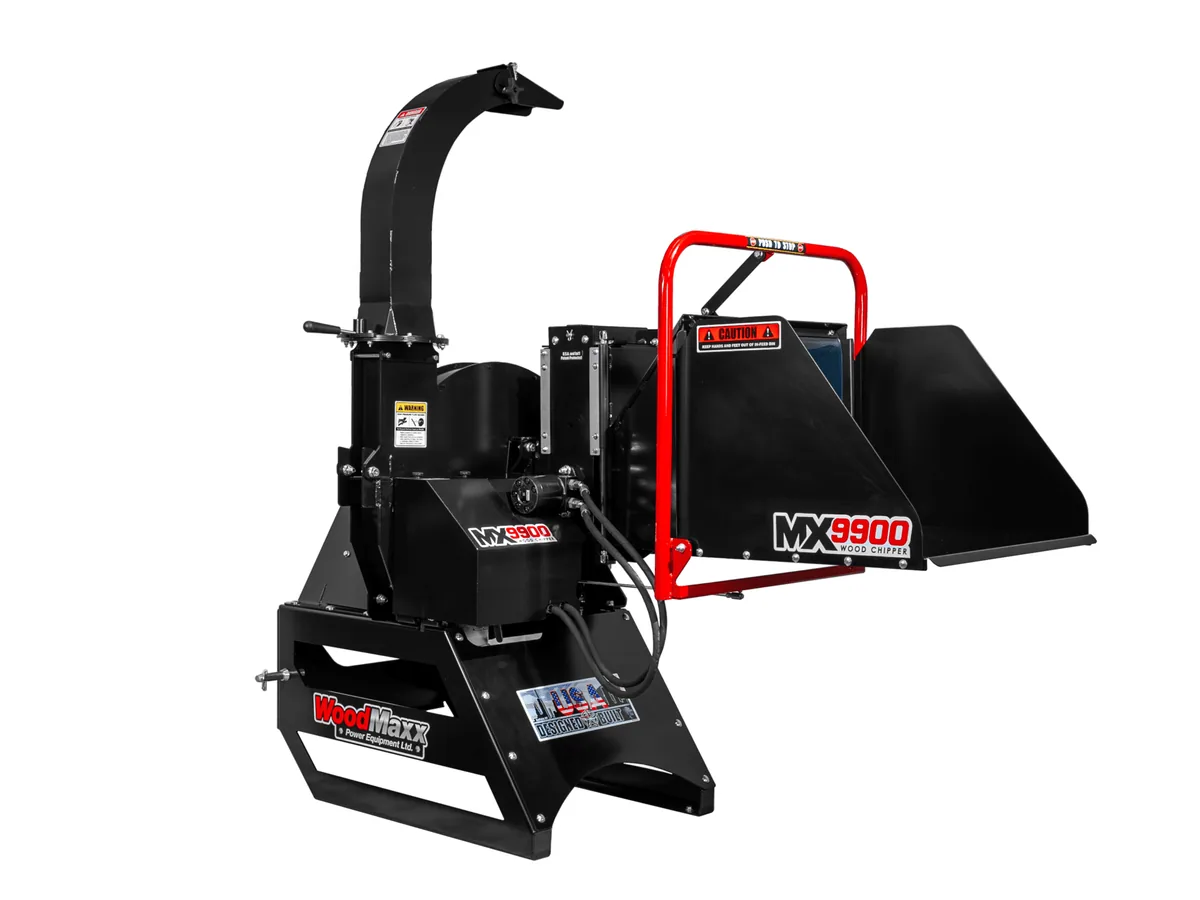
Flagship USA-made 9-inch PTO chipper — 'The Beast.' Patented POW-R-TORQ™ hydrostatic infeed, 225 lb flywheel, 4 offset A8 knives, fold-up infeed bin, 100% assembled on delivery. 25 HP minimum, 7-year transferable warranty.
Woodmaxx MX-9900 on a utility tractor: 9-inch hydraulic-feed PTO chipper demo
Owner-operator walkthrough of hitching the MX-9900 to a utility tractor and running 6"+ hardwood through the hydraulic feed.
Chip It Right is reader-supported. When you buy through links on this site, we may earn an affiliate commission at no extra cost to you. As an Amazon Associate we earn from qualifying purchases. Our editorial recommendations are never influenced by affiliate relationships — we recommend the best product for your situation, whether or not it pays us.
- Largest in the Woodmaxx line — 9-inch 9×9 in infeed opening
- POW-R-TORQ™ patented hydrostatic infeed — 0–75 ft/min variable speed with full reverse
- 225 lb dynamically balanced flywheel, 4 offset USA-made A8 tool steel knives
- 7-year transferable warranty
- USA made (Buffalo, NY)
- 100% assembled upon delivery
- Fold-up infeed bin + hinged hopper for easy service access (exclusive features)
- Price premium — $1,125 more than MX-8800 for 1-inch more capacity
- Needs 50+ HP to chip full 9-inch material; 25 HP gives 5-inch hard / 7-inch soft
Why the 9-inch capacity is real, not marketing
Owners on TractorByNet and OrangeTractorTalks consistently report feeding actual 9-inch material through the MX-9900 without bogging the tractor — the 26.5-inch dynamically balanced flywheel stores 225 lb of cutting energy, which is what makes a true 9-inch chip possible on a sub-$7,500 machine. The 27-inch wide by 18-inch tall infeed funnels down to a 9x9 opening, so crooked yard limbs, forks, and brushy hardwood tops actually fit. This is the largest infeed mouth of any sub-commercial PTO chipper.
The POW-R-TORQ hydrostatic feed runs on two quarts of motor oil instead of the seven gallons of hydraulic fluid the older WM-8H needs, which means less mess, fewer leak points, and infinitely variable feed from a creep to 75 ft/min. Reversible feed lets you back out jams and re-orient forked branches without shutting down the tractor. On clean straight oak at 8 inches, owners report roughly half a ton of chips per hour with a 65–75 HP tractor.
How much tractor HP does the Woodmaxx MX-9900 need?
Woodmaxx rates the MX-9900 for 25–100 PTO HP. The 25 HP minimum is the PTO floor to operate the machine. At 25 HP you chip 5-inch hardwood and 7-inch softwood; full 9-inch hardwood capacity requires 50+ PTO HP. Verified owner reviews confirm chipping 6-inch white oak on a 28.8 PTO HP tractor without stalling. Realistically, plan for 50+ PTO HP if you intend to chip 9-inch dense material continuously. A Kubota L4060 (40 HP class), John Deere 4066R (66 HP), Kubota MX5400 (55 HP), or Mahindra 4540 are in the right range for full capacity.
The MX-9900 ships at 1,048 lb. The other gating constraint is three-point hitch lift — verify your tractor's rated lift capacity at the ball ends before ordering. Category 1 hitches on utility-class tractors typically lift 1,800–2,500 lb at the pins; most 25+ HP compact tractors handle the MX-9900's 1,048 lb shipping weight easily. Woodmaxx will not refund freight on a chipper your tractor cannot handle.
MX-9900 vs MX-8800: is 9 inches worth the upcharge
The MX-8800 is the same hydrostatic platform with an 8-inch infeed and the same 7-year MX-Series warranty for around $1,125 less ($6,225 vs $7,350). The math is straightforward: if more than maybe 10% of your material is genuinely over 8 inches in diameter, the MX-9900 pays for itself in not having to bypass that fork or split that limb. If your wood is mostly 4–7 inch yard brush, the MX-8800 will keep up just fine and you bank the difference toward a spare set of A8 tool-steel blades.
The MX-9900 also gets commercial-grade bearings and a heavier feed roller assembly that the MX-8800 does not. Owners running side-gig tree work or maintaining 20+ wooded acres tend to choose the MX-9900 specifically for the duty-cycle headroom, not just the extra inch of capacity. For a one-property homeowner, that headroom is overkill.
The ceiling: when you should buy commercial dealer-network instead
The MX-9900 tops out at light-commercial duty. If you run a tree service that chips daily, you want a self-powered tow-behind from Vermeer, Bandit, or Morbark — a Vermeer BC600XL (6-inch) starts around $15,000 used and BC900XL towables are $20,000+ used, $40,000+ new, with their own diesel engine and DOT-legal trailer. A Bandit M-Series Intimidator is similar territory. Those are real commercial machines with autofeed control systems, hydraulic winches, and parts networks that the MX-9900 does not pretend to compete with.
Step up from the MX-9900 only if (a) you're running it as your primary daily revenue tool, (b) you need to chip off-grid without tying up a tractor for hours, or (c) you regularly chip 10-inch hardwood. The closest direct competitor in three-point territory is the Wallenstein BX102S at 10-inch capacity for roughly $2,000 more — but the BX102S is gravity feed, not hydraulic, and requires 65–150 HP. For most landowners buying a tractor chipper in 2026, the MX-9900 is the natural top of the line; the next real step up is a different machine class entirely.
What's in the box
- MX-9900 chipper unit
- PTO shaft with shear pin (540 RPM)
- Blade set (4 knives, installed)
- Hydraulic feed roller assembly (installed)
- Hydraulic hoses and fittings (for tractor remote hookup)
- 3-point hitch pins (Cat II)
- Discharge chute with deflector
- Hardware bag
- Operator manual
- Hydraulic fluid — check tractor reservoir level (system uses tractor remotes)
- Tractor (40–100 HP with 540 RPM PTO and rear hydraulic remotes)
- Quick-hitch adapter (if your tractor uses one)
- Ear protection and safety glasses
Ships freight. Largest Woodmaxx PTO chipper — verify your tractor's 3-point hitch lift capacity (min ~1,650 lb) before ordering. 7-year warranty registration required within 30 days.
Woodmaxx MX-9900 9-inch Hydrostatic-Feed PTO Woodchipper specs at a glance
- Brand
- Woodmaxx
- Model
- MX-9900
- Power type
- pto
- Max branch diameter
- 9"
- Power
- PTO-driven, 25–100+ HP tractor (50+ HP for full 9-inch capacity)
- Feed system
- Hydraulic
- Weight
- 1048 lb
- Price (MSRP)
- $7,350
- Warranty
- 7 years
Will the MX-9900 fit my tractor?
The Woodmaxx MX-9900 9-inch Hydrostatic-Feed PTO Woodchipper needs 25–100 PTO HP. Here’s how 26 common compact and utility tractors match up — rated PTO HP, not engine HP (after typical 10–15% drivetrain losses).
| Tractor | Engine HP | PTO HP | Hitch | MX-9900 verdict |
|---|---|---|---|---|
| Kubota BX23S | 22 | 15 | Cat 1 | Too small |
| Kubota LX2610 | 25 | 19 | Cat 1 | Too small |
| Kubota L2501 | 24 | 19 | Cat 1 | Too small |
| Kubota L3301 | 33 | 26 | Cat 1 | Fits |
| Kubota L3901 | 37 | 30 | Cat 1 | Fits |
| Kubota L4701 | 47 | 38 | Cat 1 | Fits |
| Kubota MX5400 | 55 | 45 | Cat 2 | Fits |
| Kubota M4-071 | 70 | 58 | Cat 2 | Fits |
| John Deere 1025R | 24 | 18 | Cat 1 | Too small |
| John Deere 2025R | 25 | 19 | Cat 1 | Too small |
| John Deere 3025E | 24.7 | 19 | Cat 1 | Too small |
| John Deere 3032E | 32 | 25 | Cat 1 | Fits |
| John Deere 3039R | 38.2 | 30 | Cat 1 | Fits |
| John Deere 3046R | 45.3 | 37 | Cat 1 | Fits |
| John Deere 4044M | 43.1 | 35 | Cat 1 | Fits |
| John Deere 4066R | 65.9 | 53 | Cat 2 | Fits |
| Mahindra 1533 | 33 | 26 | Cat 1 | Fits |
| Mahindra 2638 HST | 37.4 | 29 | Cat 1 | Fits |
| Massey Ferguson 1735M | 35 | 28 | Cat 1 | Fits |
| Massey Ferguson 2705E | 49 | 40 | Cat 2 | Fits |
| New Holland WORKMASTER 25S | 24.7 | 18 | Cat 1 | Too small |
| New Holland WORKMASTER 35 | 35 | 28 | Cat 1 | Fits |
| Kioti CK2620 | 24.5 | 20 | Cat 1 | Too small |
| Kioti NX4510 | 45 | 38 | Cat 1 | Fits |
| LS MT225S | 24.4 | 18 | Cat 1 | Too small |
| LS MT342 | 41.3 | 32 | Cat 1 | Fits |
“Fits” = within the manufacturer’s rated PTO HP range. “At limit” = below the minimum by 5–15%, will feel underpowered on seasoned hardwood. “Too small” = undersized for reliable chipping. “Oversized” = above range (works but overkill).
Who should buy the MX-9900 — and who should skip it
- You run a 25+ HP tractor and want the most capable PTO chipper under $10,000 with a 7-year warranty
- You routinely clear material in the 7–9 inch range and the MX-8800's 8-inch limit would force you to bypass real branches
- You want the longest warranty in the category — 7 years transferable on the MX-Series, versus 3 years on the WM-8H and Wallenstein BX series
- You value the hydrostatic feed's simplicity — two quarts of motor oil instead of seven gallons of hydraulic fluid, fewer leak points, infinitely variable feed
- You want the biggest direct-to-consumer PTO chipper without entering Vermeer or Bandit dealer-network commercial territory at $15K+
- You run a light-commercial side gig (small lot clearing, single-property tree work) and need duty-cycle headroom the MX-8800 cannot provide
- You want USA-made equipment — MX-9900 is manufactured at Woodmaxx's Buffalo, NY facility
- Your tractor is under 25 PTO HP — look at the MX-8600 (15 HP min) or WM-8H (19 HP min) instead
- Your budget is under $6,000 — the WM-8H ($4,095) or MX-8800 ($6,225) are the right alternatives
- Most of your material is under 7 inches — the MX-8800 saves you roughly $1,125 with the same warranty and feed system
- You chip daily as your primary revenue — buy a self-powered Vermeer BC600XL/BC900XL or Bandit M-Series, not a tractor-mounted unit
- You actually need 10-inch capacity — step to the Wallenstein BX102S (gravity feed, 65–150 HP, around $9,000) or commercial dealer brands
- You want a gravity-feed chipper because hydraulic systems intimidate you — the WM-8M or BX102S are simpler mechanical alternatives, though they jam more on crooked material
Alternatives to the MX-9900
$1,125 less. 8-inch capacity (1 inch smaller).
$3,355 less. 8-inch capacity (1 inch smaller). 3-year warranty. from Woodland Mills.
$1,890 more. 10-inch capacity (1 inch larger). mechanical feed (simpler, cheaper). 5-year warranty. from Wallenstein.
See all picks: best PTO wood chippers ranked by tractor HP.
MX-9900 accessories & add-ons
Set of 4 replacement chipper knives for the MX-9900. Available from woodmaxx.com.
Replacement hydraulic feed hoses and fittings. Larger diameter than 8-inch models.
Heavy-duty PTO shaft shear pins for the MX-9900.
Upgraded PTO shaft rated for the 40–100 HP range with wide-angle CV joints.
Cat II quick-hitch adapter. Verify compatibility with your specific quick-hitch brand.
MX-9900 blade replacement & sharpening
Thickest A8 flywheel knives in the Woodmaxx line — expect 45+ hours per edge on clean hardwood.
9-inch throat means bigger chips and more impact load; inspect bolts each sharpening and replace stretch-marked ones.
Factory-only replacements; aftermarket blanks for the 9-inch are thin on the ground.
- Blade count
- 2 flywheel knives
- Bed knife
- Yes — fixed anvil
- Sharpening angle
- 30–40°
- Reversible
- Yes — doubles edge life
- Blade material
- A8 tool steel
- Replacement set
- $210–$280
- Sharpening interval
- 30–50 hours
- Bolt torque
- 55–65 ft-lb
- 01Stop the machine and isolate power
Disengage the PTO, shut the tractor off, and remove the key. Wait 60+ seconds for the MX-9900 flywheel to stop completely — it coasts longer than the engine.
- 02Open the discharge or flywheel access cover
Remove the bolts on the MX-9900 flywheel access hood (or flip the hinged hood if equipped). Swing it clear so you have line-of-sight to every blade position.
- 03Rotate the flywheel to the first blade
Turn the flywheel by hand until the first of the 2 knives is aligned with the access opening. Mark it "1" with a paint pen so you can keep track of orientation.
- 04Break the blade bolts loose
Use a breaker bar on each of the 2 blade bolts. Woodmaxx and Woodland Mills both thread-lock these at the factory; heat gently if they don't yield. Do not pry on the flywheel itself.
- 05Slide the blade out and inspect
Remove the blade and inspect for cracks, nicks deeper than 1/16", and rounded bevels. A cracked blade goes straight in the scrap bin — never re-sharpened.
- 06Flip or replace the blade
The MX-9900 uses 2 reversible knives. If the secondary edge is still clean, simply flip the blade for a fresh edge. If both edges are worn, sharpen at 30–40° on a belt sander — quench every 10–15 seconds to avoid bluing the A8 tool steel.
- 07Balance the set
Remove equal material from every blade in the set. On the MX-9900's 2-knife flywheel, even a 1–2 gram imbalance shows up as vibration at operating RPM. Weigh on a gram scale after sharpening.
- 08Reinstall and torque
Apply anti-seize to the bolt threads (not the heads) and torque in a star pattern to 55–65 ft-lb. Use fresh lock washers — reused washers are the #1 cause of a loose blade downstream.
- 09Repeat for every remaining blade
Rotate the flywheel and repeat steps 3–8 for the remaining 1 knives. Then inspect the fixed bed knife — if the edge is rounded, flip or replace it and reset the blade-to-anvil gap to ~0.030" with feeler gauges.
- 10Close up and test-run
Rotate the flywheel by hand one full revolution to confirm no contact with the bed knife or housing. Close the access cover. Start the tractor, engage PTO at low idle, and listen for 30 seconds before ramping to operating RPM. Feed one small test branch before returning to normal work.
Not sure the MX-9900 is the right size for your branches?
The Woodmaxx MX-9900 9-inch Hydrostatic-Feed PTO Woodchipper handles branches up to 9 inches. Use the free HP calculator to check whether your tractor or engine has enough power for your specific branch diameter and wood type.
Check HP requirements for your branchesMX-9900 — frequently asked questions
- What tractor lift capacity do I need for the MX-9900?
- The MX-9900 ships at 1,048 lb. Most 25+ HP compact tractors with Cat 1 or Cat 2 hitches handle this easily — typical Cat 1 lift capacity at the ball ends is 1,800–2,500 lb. Check your tractor's rated lift at the ball ends (not lower link arms) before ordering. The 1,048 lb shipping weight is well within the lift range of most compact utility tractors.
- Is the MX-9900 worth $1,125 more than the MX-8800?
- Only if you regularly feed material over 8 inches in diameter, or you're running it as a side-gig tree-service rig. The 9-inch infeed and heavier commercial bearings buy you duty-cycle headroom and one extra inch of capacity. For typical landowner brush cleanup with branches under 8 inches, the MX-8800 keeps up at $1,125 less and uses the same hydrostatic feed and 7-year warranty.
- Can the MX-9900 chip 9-inch oak or maple at full feed?
- Yes, with caveats. Owners report feeding actual 9-inch hardwood successfully, but at the top end of the capacity you slow the feed and let the flywheel work. Continuous 9-inch seasoned oak is not the duty cycle this machine is designed for. The realistic comfort zone is 7–8 inch hardwood at steady feed, with 9-inch material handled deliberately rather than continuously.
- Is the MX-9900 viable for a side-gig tree service?
- Yes for light-commercial work — small lot clearing, storm cleanup, single-property tree removals where you're already towing a tractor. Not for daily commercial chipping. The 7-year MX-Series warranty covers consumer use; sustained 40+ hour weeks will burn through blade life and bearings faster than the warranty assumes. If chipping is your primary revenue, a Vermeer BC600XL or Bandit M-Series is the right tool.
- How does the hydrostatic feed compare to traditional hydraulic feed?
- The POW-R-TORQ system is a self-contained hydrostatic loop that uses two quarts of motor oil instead of several gallons of hydraulic fluid. In practice you get the same reversible variable-speed feed as a traditional hydraulic chipper, with less fluid volume to leak, simpler service, and infinitely variable speed from creep to 75 ft/min. Owners coming from the older WM-8H consistently rate the hydrostatic feed as the bigger real-world upgrade over the extra inch of capacity.
- Does the MX-9900 require Category 2 hitch, or will Category 1 work?
- Woodmaxx ships it as Category 1 and Category 2 compatible. Most 40–60 HP utility tractors run a Cat 1 hitch and handle the MX-9900 fine; larger 70+ HP tractors typically use Cat 2 pins. The pin size is not the gating issue — lift capacity at the pins is. Confirm your tractor's actual rated lift at the ball ends, not just the hitch category designation.
- What are the common problems with the MX-9900?
- The most-reported issues are: hydraulic feed sensitivity (the safety bar can trip on long brush, which is by design), discharge chute clogging on wet chips (clear periodically), and paint chips from freight shipping (cosmetic only). None are mechanical defects — they're operational characteristics owners adapt to within the first few sessions.
- MX-9900 vs bandit chipper — which should I buy?
- See our head-to-head comparison for the detailed breakdown. In short: the MX-9900 at $7,350 offers 9-inch capacity with hydraulic feed. The right pick depends on your tractor HP, branch size, and whether you need hydraulic feed for forked material.
- MX-9900 vs mx-8800 — which should I buy?
- See our head-to-head comparison for the detailed breakdown. In short: the MX-9900 at $7,350 offers 9-inch capacity with hydraulic feed. The right pick depends on your tractor HP, branch size, and whether you need hydraulic feed for forked material.
- How much HP do I need to run the MX-9900?
- The MX-9900 needs 25–100 PTO HP. That's PTO horsepower (roughly 85–90% of engine HP). A 29 HP engine tractor produces about 25 PTO HP. Comfortable range: 31–90 PTO HP.
- What warranty does the MX-9900 come with?
- Woodmaxx covers the MX-9900 with a 7-year warranty. This is the MX-Series warranty — the longest in the PTO chipper category. Covers manufacturing defects; excludes wearing parts (blades, belts) and cosmetic damage.
- What can the MX-9900 actually chip in real-world use?
- Rated for 9-inch branches. In practice, green softwood chips reliably at rated max. Seasoned hardwood at 9 inches slows the feed rate and bogs the flywheel on knots — comfortable working capacity on hardwood is 7.5–8.5 inches. The hydraulic feed handles forked and crooked material well.
- Is the MX-9900 worth buying?
- At $7,350, the MX-9900 is the premium/commercial tier — justified only for high-volume use or buyers who need max capacity. The 7-year warranty provides strong long-term protection.