How to choose a woodchipper
A practical framework for picking the right woodchipper based on what you own, what you'll chip, and how often. Four decisions, in order — get them right and the model choice is almost automatic.
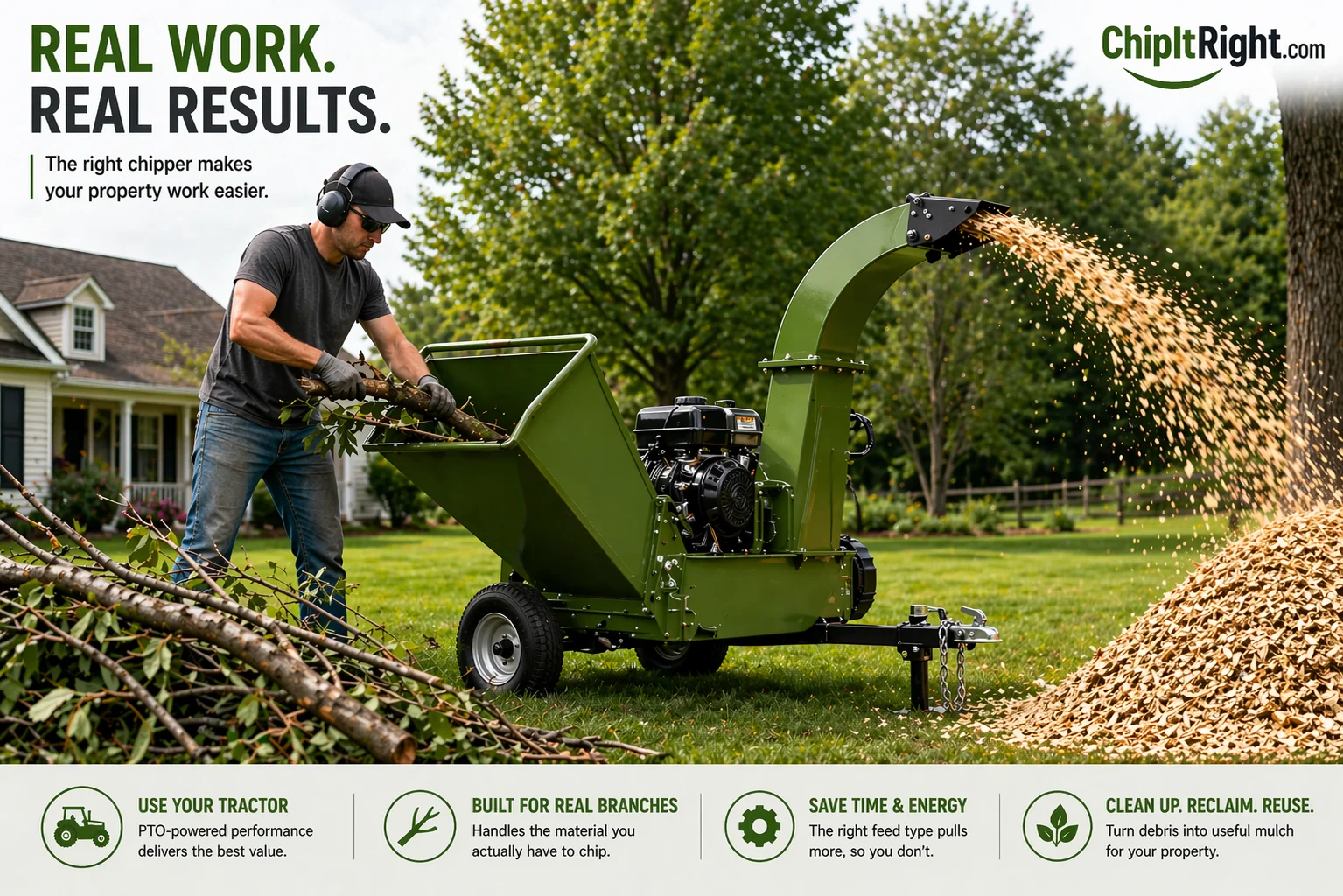
Buying a woodchipper is a high-ticket decision — $1,000 to $9,000+ — and most buyers only do it once. The single biggest mistake is shopping by price or brand first. The right approach is four decisions, made in this order: power type, capacity, feed type, then brand.
This guide walks through each decision with specific product recommendations, a budget chart, common mistakes to avoid, and a quick-reference table that maps your property type directly to a chipper recommendation.
Quick recommendation by property type
If you want the answer without the framework, here’s the cheat sheet. Find your situation, get our pick.
| Your setup | Type | Our pick | Price |
|---|---|---|---|
| Suburban yard, pruning | Gas 4″ | MechMaxx GS650 | $1,299 |
| 1–5 acres, no tractor | Gas 6–7″ | MechMaxx PowerDCH7 | $6,399 |
| 5+ acres, 25–45 HP tractor | PTO 6″ | Woodland Mills WC68 | $3,450 |
| 5+ acres, 30–80 HP tractor | PTO 8″ hyd. | Woodmaxx WM-8H | $4,095 |
| Premium buyer, 22–55 HP | PTO 5″ | Wallenstein BX52S | $5,150 |
| 40+ HP utility, heavy use | PTO 8–9″ | Woodmaxx MX-8800 | $6,225 |
| Tree service, multi-site | Tow-behind 8″ | MechMaxx CROBA TX1000 | $14,699 |
Want the reasoning? Keep reading — the four decisions below explain why each pick wins for its setup.
Decision 1: What power type do you need?
This is the single most important decision because it determines which products you can even consider. There are four power types, and the right one depends on one question: do you own a tractor with PTO?
PTO chippers run off your tractor’s PTO shaft. They are the best value per dollar in the woodchipper category — you’re leveraging the engine you already own, so you only pay for the chipping mechanism. A Woodmaxx WM-8H (8-inch hydraulic feed) costs $4,095; an equivalent gas-standalone chipper at 8-inch hydraulic feed costs $14,699+. That $10,600 delta is entirely the engine and the tow-behind chassis.
Gas-standalone chippers have their own gasoline engine. Buy one only if you don’t have a tractor, or if you specifically need portability (chipping at a neighbor’s property, moving between sites without towing a tractor). The MechMaxx DCH7 with its Honda GX engine is the benchmark in this category.
Electric chippers are plug-in or battery. Quiet, no fumes, no fuel hassle — but capacity tops out around 2.5 inches and feed rate is slow. Appropriate only for suburban pruning. See our electric vs gas comparison for the full tradeoff.
Tow-behind chippers are self-powered on a DOT-legal trailer frame. Built for tree-service crews who move between job sites. If you’re not a commercial crew, this category is overkill. See our tow-behind guide.
For a deeper dive: PTO vs gas woodchipper — the complete comparison.
Power type is not the same as chipper versus shredder. If your pile is leaves, vines, or garden waste rather than limbs, settle woodchipper vs wood shredder first. A PTO or gas chipper will jam on leafy material a shredder is built to tear.
Decision 2: What capacity (branch diameter) do you need?
Capacity is measured by maximum branch diameter in inches. The critical rule: size to your 80th-percentile branch, not your peak. If you chip 4-inch branches 95% of the time and hit an 8-inch log once a year, buy a 6-inch chipper and chainsaw the rare large log into manageable pieces.
- Under 3 inches → 4-inch chipper is enough. Entry-tier gas like the MechMaxx GS650 or PTO like the Wallenstein BX36S.
- 3–5 inches → 5–6 inch chipper. The sweet spot for most property owners. The Woodland Mills WC68 (PTO) or MechMaxx B150 (gas) cover this tier.
- 5–7 inches → 7–8 inch chipper. Step up to the Woodmaxx WM-8H (PTO, hydraulic) or MechMaxx DCH7 (gas, Honda GX).
- 7+ inches regularly → 8–9 inch with hydraulic feed. The Woodmaxx MX-8800 (PTO) or MX-9900 (9-inch PTO, commercial-grade).
For the detailed sizing chart by property acreage, see What size woodchipper do I need?
Decision 3: What feed type do you need?
Feed type is the most underestimated decision. It determines how much physical work you do while chipping and how well the machine handles irregular material.
Manual feed — you push each branch in by hand. Found on all electric chippers and entry-tier gas chippers (MechMaxx GS650, Woodmaxx DC-1260). Acceptable for occasional chipping of clean, straight material. Fatiguing on sessions over an hour.
Mechanical self-feed — gravity-fed rollers driven by the flywheel pull branches in automatically. Standard on mid-tier PTO chippers (Woodland Mills WC68, Woodmaxx MX-8600, Wallenstein BX52S). Works well on clean, straight branches. Hangs up on forked or crooked limbs — you’ll need to manually nudge material through on occasion.
Hydraulic feed — a dedicated hydraulic pump powers the infeed rollers independently of the flywheel. Found on the Woodmaxx WM-8H, MX-8800, MX-9900, Woodland Mills WC88, and the MechMaxx CROBA TX1000. Handles forked, crooked, and limby material that mechanical feeds stall on. Reversible for jam recovery. Worth the $500–$1,500 premium for anyone who regularly chips storm debris or unprocessed brush.
The rule: if your material is mostly clean and straight, mechanical self-feed saves money. If you chip forked, crooked, or limby brush, pay for hydraulic — you’ll recoup the premium in productivity within the first season.
Decision 4: Which brand?
We cover four brands in depth. Each occupies a different position:
- Woodmaxx — PTO-first, US-assembled from Akron, NY. 7-year MX-Series warranty (longest in the category). The default PTO brand for most buyers. Best value at 8-inch hydraulic feed.
- Woodland Mills — Canadian PTO brand. The WC68 is the most-recommended chipper for 30–40 HP compact tractors. 5-year warranty. Heavy flywheels. Direct-to-consumer.
- MechMaxx — Gas-standalone specialist. Five gas chippers from homeowner to commercial. The DCH7 (Honda GX 22 HP) is the standout. Buy MechMaxx if you don’t own a tractor.
- Wallenstein — Premium Canadian PTO builder. Overbuilt chassis, broad dealer network, 5-year warranty. 25–40% more expensive than Woodmaxx/Woodland Mills at equivalent capacity. Buy if you value build quality and a dealer relationship over value.
For head-to-head brand breakdowns, see MechMaxx vs Woodmaxx and Wallenstein vs Woodmaxx.
What most first-time buyers get wrong
Five mistakes we see repeated across every tractor forum:
- Buying to the peak instead of the 80th percentile. You chip 4-inch branches 50 times a year and an 8-inch log once. Buying an 8-inch chipper for the rare log means paying 40–60% more for capability you barely use. Buy the 6-inch and chainsaw the exception.
- Ignoring PTO HP vs engine HP. A 35 HP engine tractor produces roughly 30 PTO HP after drivetrain losses. If a chipper needs 30 PTO HP minimum, your 35 HP tractor is at the ragged edge, not comfortable. Use our HP sizing calculator to verify.
- Skipping hydraulic feed to save money. If you chip mostly straight branches from pruning, mechanical feed is fine. If you chip storm debris, yard-tree limbs, or anything forked, the $500–$1,500 for hydraulic feed pays for itself in the first season through time saved and frustration avoided.
- Buying a gas chipper when you own a tractor. PTO chippers deliver 30–40% more capacity per dollar than gas-standalone. Unless you specifically need portability away from the tractor, the PTO chipper is the right answer.
- Not checking 3-point hitch lift capacity. An 8-inch PTO chipper weighs 1,100–1,400 lb. Category 1 tractors typically lift 1,200–1,800 lb at the hitch pins. If your chipper is at or near the lift limit, the tractor struggles to raise and lower it — check your tractor’s specs before ordering.
- Waiting for wood to dry before chipping. Green and wet wood is easier on blades than dry seasoned wood. The real risk is a clogged chute, not blade damage. See can you chip wet wood.
What to expect to spend in 2026
Budget ranges by capacity tier, based on current manufacturer pricing:
| Capacity | PTO price | Gas price | Annual upkeep |
|---|---|---|---|
| 3.5–4 inch | $1,400–$2,900 | $1,100–$1,900 | $40–$80 |
| 5–6 inch | $2,700–$5,200 | $1,600–$3,500 | $60–$120 |
| 7–8 inch | $4,000–$5,500 | $3,500–$7,500 | $80–$150 |
| 9–10 inch | $7,000–$9,300 | $7,500+ | $100–$200 |
Annual upkeep includes blade sharpening (1–2x per year), belt replacement (every 2–3 years), lubricants, and shear pins. Gas chippers add oil changes, spark plugs, air filters, and fuel stabilizer. PTO chippers skip all engine maintenance — that stays on the tractor. For a deep dive, see our blade sharpening guide. Every PTO model we cover is also ranked by price per inch of capacity. For the rental-vs-buying math, use our free break-even calculator.
Safety essentials (non-negotiable)
Woodchippers are one of the most dangerous pieces of outdoor power equipment. Every season, emergency rooms treat crush injuries, lacerations, and amputations from chipper misuse. Before you buy, commit to this baseline:
- Never reach into the infeed hopper while the chipper is running. Use a push stick or let the feed rollers do the work.
- Wear hearing protection, eye protection, and gloves. Gas chippers run 100+ dB; PTO chippers run 85–95 dB. Both throw chips.
- No loose clothing, jewelry, or long hair near the infeed. Infeed rollers pull at 50–75 ft/min and don’t distinguish between a branch and a sleeve.
- Know where the emergency stop is before chipping. Hydraulic-feed chippers (WM-8H, MX-8800, WC88) have a feed-bar safety switch on the infeed bin. Learn its position by feel — you won’t be looking at it in an emergency.
- Never chip alone without someone in earshot. If something goes wrong, having a second person nearby cuts emergency response time dramatically.
These aren’t suggestions — they’re the minimum. Always read the manufacturer’s operating manual before first use.
Next steps: use our free tools
Once you know your power type and rough capacity tier, two free tools narrow the field to specific models:
- HP sizing calculator — enter your branch diameter, wood type, and power source. Get minimum and comfortable HP, plus matched chippers from our review database.
- Rental vs buying calculator — compare total rental cost against ownership for your chipper class and usage pattern.
Or browse all 21 models we review: All woodchipper reviews →
Frequently asked questions
- What size woodchipper do I need for 5 acres?
- A 5-acre property with typical brush cleanup is well-served by a 6-inch chipper. If you have mature hardwoods and regularly deal with storm debris, step up to 8-inch hydraulic feed. Don't undersize — feed rate is the biggest complaint with too-small chippers.
- What's the best woodchipper for a beginner?
- For a tractor owner: Woodland Mills WC68 ($3,450 MSRP / $3,275 sale, 6-inch, hydraulic feed, 3-year warranty). For a non-tractor owner: MechMaxx B150 ($2,599, 6-inch gas chipper, 15 HP Zonsen, 2-year warranty). Both are forgiving, well-documented, and have strong forum communities for support.
- Should I buy new or used?
- For consumer-grade chippers under $3,000 new, buy new — used 4-inch gas chippers hold little value and usually arrive with engine issues. For PTO and commercial-grade chippers ($3,000+), used can be a great value if the previous owner maintained blades and the flywheel bearings are tight. Always inspect blades, bearings, feed rollers, and PTO shaft before buying used.
- How often will I use a woodchipper?
- Most property owners chip 3–8 sessions per year, 2–6 hours each — roughly 10–40 hours annually. This usage profile makes a well-built chipper (Woodmaxx MX-Series, Woodland Mills, MechMaxx DCH7) economically sensible — you'll wear through blades but not through the machine.
- Do I need a tractor for a woodchipper?
- No, but if you have one with 18+ PTO HP, a PTO chipper gives you 30–40% more capacity per dollar than gas. If you don't have a tractor, a gas-standalone chipper is the right call — don't buy a tractor just to run a chipper.
- What's the difference between a woodchipper and a wood shredder?
- Chippers slice branches with blades against an anvil — output is clean, uniform chips. Shredders tear leafy debris with flails or hammers — output is coarse mulch. Some machines (combination chipper/shredders like the Patriot CSV-2515H or DR Wood Chipper-Shredders) do both. See our full breakdown: woodchipper vs wood shredder.
- How much HP does a woodchipper need?
- Roughly 3–4 HP per inch of branch diameter. A 6-inch chipper needs ~25 PTO HP; an 8-inch needs ~30 PTO HP. Use our free HP sizing calculator for your exact setup — it accounts for wood species and power source.
- Is a woodchipper worth buying vs renting?
- Buying breaks even after roughly 6–10 rental days. Rentals run $150–$350/day for a 6-inch towable. If you'll chip more than once a year for 3+ years, buying is cheaper. Use our free break-even calculator for your specific numbers.
- Can I chip wet or green wood?
- Yes — green wood is actually easier on chipper blades than dry seasoned wood. The only issue with wet wood is soggy chips clogging the discharge chute. Rotten or dirt-embedded wood is the real hazard to avoid. See our full guide: can you chip wet wood?
- What should I do with the wood chips?
- Garden mulch (2–4 inches deep around trees and shrubs), pathway material, composting carbon source, smoking wood (fruit/nut species only), animal bedding, weed suppression, or give them away. See our full list: 8 uses for wood chips.